Maybe Theyre Trying to Do Another John F Kennedy Come Again
Life of John F. Kennedy
Growing Upward in the Kennedy Family
Rose Fitzgerald Kennedy, who was a very disciplined and organized woman, made the post-obit entry on a notecard, when her second child was born:
John Fitzgerald Kennedy
Born Brookline, Mass. (83 Beals Street) May 29, 1917

In all, Rose Fitzgerald Kennedy would take nine children, four boys and five girls. She kept notecards for each of them in a small wooden file box and fabricated a bespeak of writing downward everything from a doctor's visit to the shoe size they had at a particular age. John Fitzgerald Kennedy was named in accolade of Rose's father, John Francis Fitzgerald, the Boston Mayor popularly known as Dearest Fitz. Earlier long, family and friends chosen this small blue-eyed infant, Jack. Jack was non a very healthy babe, and Rose recorded on his notecard the childhood diseases from which he suffered, such as: "whooping cough, measles, chicken pox."
On February 20, 1920 when Jack was not nevertheless three years old, he became ill with scarlet fever, a highly contagious and so potentially life-threatening disease. His father, Joseph Patrick Kennedy, was terrified that little Jack would dice. Mr. Kennedy went to the hospital every day to exist past his son's side, and about a month later Jack took a turn for the better and recovered. But Jack was never very good for you, and considering he was always suffering from i ailment or another his family used to joke most the great chance a mosquito took in biting him – with some of his blood the musquito was virtually certain to die!
When Jack was three, the Kennedys moved to a new home a few blocks away from their quondam business firm in Brookline, a neighborhood just outside of Boston. It was a lovely house with twelve rooms, turreted windows, and a large porch. Total of free energy and ambition, Jack's father worked very hard at becoming a successful businessman. When he was a pupil at Harvard College and having a hard time fitting in as an Irish Catholic, he swore to himself he would make a meg dollars by the age of 35. There was a lot of prejudice against Irish gaelic Catholics in Boston at that time, merely Joseph Kennedy was determined to succeed. Jack's bang-up-grandparents had come from Republic of ireland and managed to provide for their families, despite many hardships. Jack'south grandfathers did even better for themselves, both condign prominent Boston politicians. Jack, because of all his family unit had done, could enjoy a very comfortable life. The Kennedys had everything they needed and more.
By the fourth dimension Jack was eight there were vii children altogether. Jack had an older brother, Joe; iv sisters, Rosemary, Kathleen, Eunice, and Patricia; and a younger brother, Robert. Jean and Teddy hadn't been built-in all the same. Nannies and housekeepers helped Rose run the household.

At the stop of the schoolhouse year, the Kennedy children would go to their summer home in Hyannis Port on Cape Cod where they enjoyed swimming, sailing, and playing touch football. The Kennedy children played hard, and they enjoyed competing with one some other. Joseph Sr. encouraged this competition, especially among the boys.
He was a begetter with very high expectations and wanted the boys to win at sports and everything they tried. Equally he oftentimes said, "When the going gets tough, the tough go going." But sometimes these competitions went too far. In one case when Joe suggested that he and Jack race on their bicycles, they collided head-on. Joe emerged unscathed while Jack had to have twenty-eight stitches. Because Joe was 2 years older and stronger than Jack, whenever they fought, Jack would usually get the worst of it. Jack was the but sibling who posed any real threat to Joe's dominant position as the oldest kid.
Jack was very popular and had many friends at Choate, a boarding school for adolescent boys in Connecticut. He played tennis, basketball game, football, and golf and besides enjoyed reading. His friend Lem Billings remembers how unusual it was that Jack had a daily subscription to theNew York Times. Jack had a "clever, individualist mind," his Head Master once noted, though he was not the best student. He did not always work as hard as he could, except in history and English, which were his favorite subjects.
"Now Jack," his begetter wrote in a letter 1 day, "I don't want to give the impression that I am a nagger, for goodness knows I think that is the worse affair any parent tin can exist, and I also feel that you know if I didn't really feel you had the appurtenances I would be most charitable in my mental attitude toward your failings. Afterward long experience in sizing upwardly people I definitely know you lot take the goods and you tin go a long way…It is very difficult to make up fundamentals that you take neglected when you lot were very young, and that is why I am urging you to do the all-time you can. I am non expecting too much, and I will not be disappointed if you don't turn out to exist a real genius, but I think you lot can exist a really worthwhile citizen with proficient judgment and understanding."
Jack graduated from Choate and entered Harvard in 1936, where Joe was already a student. Similar his brother Joe, Jack played football game. He was not as good an athlete as Joe but he had a lot of conclusion and perseverance. Unfortunately, 1 twenty-four hours while playing he ruptured a deejay in his spine. Jack never really recovered from this blow and his dorsum continued to bother him for the balance of his life.
The two eldest boys were attractive, agreeable, and intelligent young men and Mr. Kennedy had high hopes for them both. All the same, information technology was Joe who had appear to anybody when he was a young boy that he would exist the first Catholic to become President. No one doubted him for a moment. Jack, on the other hand, seemed somewhat less ambitious. He was active in student groups and sports and he worked difficult in his history and government classes, though his grades remained just average.
Late in 1937, Mr. Kennedy was appointed United States Ambassador to England and moved there with his whole family, with the exception of Joe and Jack who were at Harvard. Because of his father's job, Jack became very interested in European politics and world affairs. Afterward a summer visit to England and other countries in Europe, Jack returned to Harvard more than eager to learn about history and regime and to proceed up with current events.
Joe and Jack oft received letters from their father in England, who informed them of the latest news regarding the conflicts and tensions that everyone feared would before long blow upwards into a total-scale war. Adolph Hitler ruled Federal republic of germany and Benito Mussolini ruled Italian republic. They both had strong armies and wanted to take land from other countries. On September i, 1939, Germany invaded Poland and World State of war II began.
By this fourth dimension, Jack was a senior at Harvard and decided to write his thesis on why Groovy Great britain was unprepared for war with Frg. Information technology was later published as a volume chosen Why England Slept. In June 1940, Jack graduated from Harvard. His father sent him a cablegram from London: "TWO THINGS I E'er KNEW Almost YOU ONE THAT YOU ARE SMART TWO THAT YOU ARE A SWELL GUY Love DAD."
World War II and a Future in Politics
Shortly after graduating, both Joe and Jack joined the Navy. Joe was a flyer and sent to Europe, while Jack was made Lieutenant (Lt.) and assigned to the S Pacific as commander of a patrol torpedo boat, the PT-109.
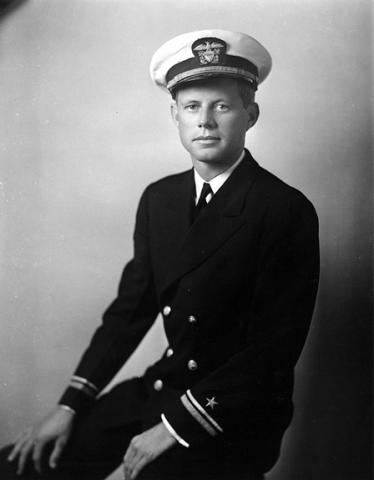
Lt. Kennedy had a crew of twelve men whose mission was to stop Japanese ships from delivering supplies to their soldiers. On the night of August two, 1943, Lt. Kennedy's coiffure patrolled the waters looking for enemy ships to sink. A Japanese destroyer suddenly became visible. Simply it was traveling at full speed and headed direct at them. Holding the wheel, Lt. Kennedy tried to swerve out of the manner, but to no avail. The much larger Japanese warship rammed the PT-109, splitting it in one-half and killing two of Lt. Kennedy's men. The others managed to bound off equally their boat went upwardly in flames. Lt. Kennedy was slammed hard against the cockpit, once again injuring his weak back. Patrick McMahon, one of his crew members, had horrible burns on his face and easily and was gear up to give upwards. In the darkness, Lt. Kennedy managed to find McMahon and booty him back to where the other survivors were clinging to a slice of the boat that was all the same afloat. At sunrise, Lt. Kennedy led his men toward a pocket-size island several miles away. Despite his own injuries, Lt. Kennedy was able to tow Patrick McMahon aground, a strap from McMahon'due south life jacket clenched between his teeth. Six days later two native islanders found them and went for aid, delivering a message Jack had carved into a piece of coconut vanquish. The next mean solar day, the PT-109 crew was rescued. Jack'southward blood brother Joe was non so lucky. He died a year later when his plane blew upwards during a dangerous mission in Europe.
When he returned habitation, Jack was awarded the Navy and Marine Corps Medal for his leadership and courage. With the war finally coming to an end, it was time to choose the kind of work he wanted to do. Jack had considered becoming a teacher or a writer, but with Joe's tragic decease suddenly everything changed. After serious discussions with Jack about his future, Joseph Kennedy convinced him that he should run for Congress in Massachusetts' eleventh congressional commune, where he won in 1946. This was the starting time of Jack's political career. As the years went on, John F. Kennedy, a Democrat, served three terms (six years) in the Firm of Representatives, and in 1952 he was elected to the US Senate.
Soon afterwards being elected senator, John F. Kennedy, at 36 years of historic period, married 24 year-former Jacqueline Bouvier, a writer with theWashington Times-Herald. Unfortunately, early on in their spousal relationship, Senator Kennedy'due south back started to hurt again and he had ii serious operations. While recovering from surgery, he wrote a book well-nigh several Usa Senators who had risked their careers to fight for the things in which they believed. The book, calledProfiles in Backbone, was awarded the Pulitzer Prize for biography in 1957. That aforementioned yr, the Kennedys' starting time child, Caroline, was born.
John F. Kennedy was becoming a popular politician. In 1956 he was almost picked to run for vice president. Kennedy nonetheless decided that he would run for president in the next ballot.
He began working very long hours and traveling all around the United states of america on weekends. On July 13, 1960 the Democratic political party nominated him as its candidate for president. Kennedy asked Lyndon B. Johnson, a senator from Texas, to run with him as vice president. In the general election on November 8, 1960, Kennedy defeated the Republican Vice President Richard M. Nixon in a very close race. At the age of 43, Kennedy was the youngest man elected president and the first Cosmic. Earlier his inauguration, his 2nd kid, John Jr., was born. His father liked to call him John-John.
John F. Kennedy Becomes The 35th President of the United States
John F. Kennedy was sworn in as the 35th president on January xx, 1961. In his countdown speech he spoke of the need for all Americans to be agile citizens. "Enquire non what your state can do for you, ask what yous can do for your country," he said. He too asked the nations of the earth to join together to fight what he chosen the "common enemies of human being: tyranny, poverty, disease, and war itself." President Kennedy, together with his married woman and ii children, brought a new, youthful spirit to the White House. The Kennedys believed that the White House should be a place to celebrate American history, culture, and achievement. They invited artists, writers, scientists, poets, musicians, actors, and athletes to visit them. Jacqueline Kennedy also shared her husband'southward interest in American history. Gathering some of the finest fine art and furniture the United States had produced, she restored all the rooms in the White House to brand it a place that truly reflected America'due south history and creative creativity. Everyone was impressed and appreciated her hard work.
The White House also seemed like a fun place considering of the Kennedys' two young children, Caroline and John-John. At that place was a pre-schoolhouse, a swimming puddle, and a tree-house exterior on the White House lawn. President Kennedy was probably the busiest human being in the country, but he still constitute time to express mirth and play with his children.
However, the president as well had many worries. I of the things he worried about well-nigh was the possibility of nuclear war between the United States and the Soviet Union. He knew that if there was a war, millions of people would dice. Since Globe War II, there had been a lot of anger and suspicion between the two countries but never any shooting betwixt Soviet and American troops. This 'Cold State of war', which was dissimilar any other war the world had seen, was really a struggle between the Soviet Matrimony's communist system of government and the United states of america' democratic system. Because they distrusted each other, both countries spent enormous amounts of coin building nuclear weapons. There were many times when the struggle betwixt the Soviet Union and the United States could take ended in nuclear state of war, such as in Cuba during the 1962 missile crisis or over the divided city of Berlin.
President Kennedy worked long hours, getting up at seven and not going to bed until eleven or twelve at night, or later. He read six newspapers while he ate breakfast, had meetings with important people throughout the day, and read reports from his advisers. He wanted to brand certain that he made the best decisions for his country. "I am request each of you lot to be new pioneers in that New Frontier," he said. The New Frontier was not a place but a way of thinking and acting. President Kennedy wanted the United States to move forward into the future with new discoveries in scientific discipline and improvements in pedagogy, employment and other fields. He wanted republic and freedom for the whole world.
I of the first things President Kennedy did was to create the Peace Corps. Through this program, which still exists today, Americans tin volunteer to work anywhere in the world where assistance is needed. They tin help in areas such equally didactics, farming, health care, and structure. Many immature men and women have served as Peace Corps volunteers and have won the respect of people throughout the globe.
President Kennedy was as well eager for the United States to atomic number 82 the way in exploring infinite. The Soviet Union was alee of the U.s. in its infinite program and President Kennedy was determined to take hold of upwards. He said, "No nation which expects to exist the leader of other nations can look to stay backside in this race for space." Kennedy was the first president to ask Congress to approve more than 22 billion dollars for Projection Apollo, which had the goal of landing an American human being on the moon before the end of the decade.
President Kennedy had to bargain with many serious problems here in the U.s.a.. The biggest trouble of all was racial discrimination. The United states of america Supreme Court had ruled in 1954 that segregation in public schools would no longer exist permitted. Black and white children, the decision mandated, should become to school together. This was now the law of the land. However, there were many schools, particularly in southern states, that did not obey this law. There was likewise racial segregation on buses, in restaurants, movie theaters, and other public places.
Thousands of Americans joined together, people of all races and backgrounds, to protestation peacefully this injustice.
Martin Luther King Jr. was ane of the famous leaders of the movement for civil rights. Many ceremonious rights leaders didn't think President Kennedy was supportive enough of their efforts. The President believed that property public protests would only anger many white people and make information technology fifty-fifty more difficult to convince the members of Congress who didn't agree with him to pass civil rights laws. By June 11, 1963, however, President Kennedy decided that the fourth dimension had come to take stronger action to aid the ceremonious rights struggle. He proposed a new Civil Rights nib to the Congress, and he went on television asking Americans to end racism. "One hundred years of filibuster have passed since President Lincoln freed the slaves, yet their heirs, their grandsons, are non fully free," he said. "This Nation was founded past men of many nations and backgrounds…[and] on the principle that all men are created equal." President Kennedy made it clear that all Americans, regardless of their peel color, should enjoy a good and happy life in the United States.
The President is Shot
On Nov 21, 1963, President Kennedy flew to Texas to give several political speeches. The next day, as his motorcar drove slowly past cheering crowds in Dallas, shots rang out. Kennedy was seriously wounded and died a short time later. Within a few hours of the shooting, constabulary arrested Lee Harvey Oswald and charged him with the murder. On November 24, another human, Jack Cerise, shot and killed Oswald, thus silencing the simply person who could have offered more information virtually this tragic event. The Warren Committee was organized to investigate the assassination and to clarify the many questions which remained.
The Legacy of John F. Kennedy
President Kennedy's death acquired enormous sadness and grief among all Americans. About people nevertheless retrieve exactly where they were and what they were doing when they heard the news. Hundreds of thousands of people gathered in Washington for the President's funeral, and millions throughout the globe watched it on tv set.
Equally the years have gone by and other presidents have written their chapters in history, John Kennedy'south brief time in role stands out in people'southward memories for his leadership, personality, and accomplishments. Many respect his coolness when faced with difficult decisions--like what to do about Soviet missiles in Cuba in 1962. Others adore his ability to inspire people with his eloquent speeches. All the same others remember his compassion and his willingness to fight for new authorities programs to assistance the poor, the elderly and the ill were most important. Similar all leaders, John Kennedy fabricated mistakes, simply he was always optimistic about the future. He believed that people could solve their common problems if they put their state'south interests first and worked together.
espinozatheromend39.blogspot.com
Source: https://www.jfklibrary.org/learn/about-jfk/life-of-john-f-kennedy
0 Response to "Maybe Theyre Trying to Do Another John F Kennedy Come Again"
Postar um comentário